Listening to the Spaces In-Between.

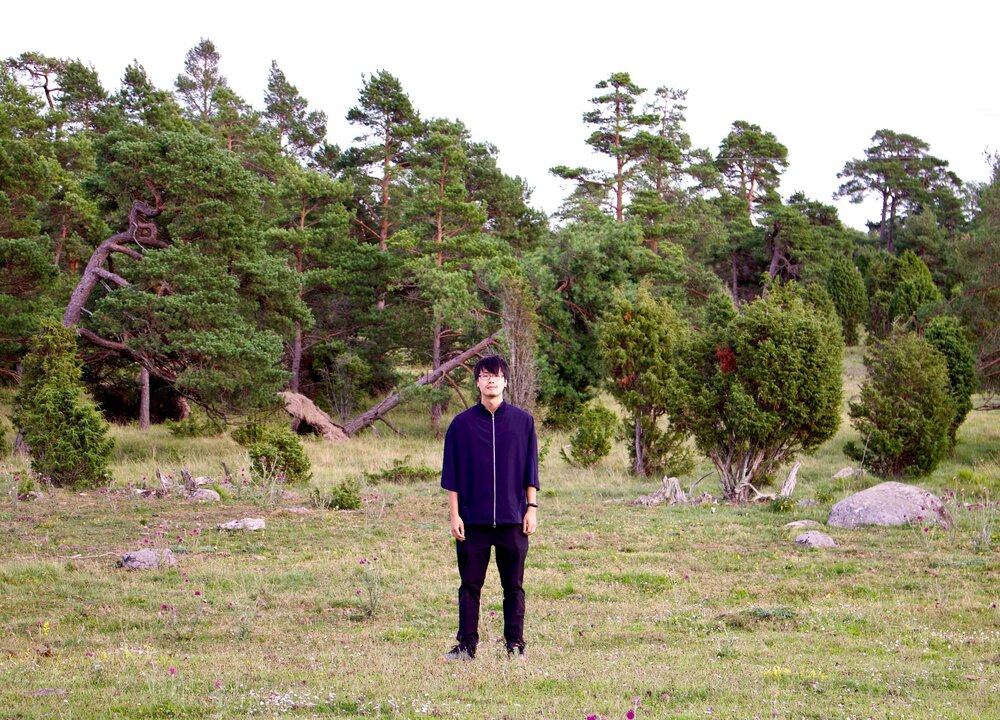
Photo by Daryl Jamieson
An interview with sound artist and composer Chatori Shimizu
by Elaine Su-Hui
This interview was conducted over email during the height of the global pandemic in May 2020 and was finalized prior to the murder of George Floyd and the widespread Black Lives Matter uprisings.
CHATORI SHIMIZU is a composer, researcher, multi-instrumentalist and sound artist, whose award-winning works have been performed and exhibited throughout the world. Ranging from orchestral works to sound installations, Chatori draws upon both Western contemporary composition as well as the aesthetic and philosophy of Japanese court music, Gagaku, in order to create pieces comprising of two main elements: sound and the ‘silent’ spaces between sounds.
I met Chatori at Pioneer Works in Brooklyn where he was exhibiting his sound installation “Somewhere Close”. Contact microphones were attached to living plants and pieces of wood, and their vibrations were being transmitted at a lower sound frequency so as to be audible to the human ear. Chatori was sitting in the midst of this assemblage, listening attentively to the subtle mewling of plants ‘singing’ while also enjoying the flux of visitors and louder ambient sounds of people drinking and socializing.
Inner Fields was not fully formed at that time, and I was actively searching for artists to give it its first legs. I immediately recognized in Chatori and his work what I had not yet been able to put into words: a combination of philosophical playfulness and curiosity; an unperturbed, receptive presence; a well-cultivated discipline or practice; and an utterly open, creative sensibility.
Chatori performed at Inner Fields during its opening week and we had to host it twice just to fit everyone in. He brought parts of his sound installation and also his shō, a traditional Gagaku wind instrument which places importance on the 間 “Ma” sound; the ‘silent’ spaces between the player’s in and out breath. Since then, Chatori and I have continued to collaborate on multiple Inner Fields events, always exploring the dynamic, living qualities of sound and what it means to listen to the spaces in-between.
~~~
Tell us a bit about what’s going on in your life right now. Is there an aspect of the natural landscape which has meaning for you at present?
Due to the global spread of Covid-19, we have seen the world grind to a halt. I, alongside many other people around the world, have had to cancel all of my upcoming schedules, including tours of my concerts, music festivals, and conferences, and self-quarantine in my apartment in Dresden (Germany). Fortunately, I have a modest south-facing balcony that receives full sun during the day, so although not necessarily a landscape, I have decided to start my own humble organic farm. With the partial lockdown and business closures in effect, I’ve had to be creative as it has been unthinkable to acquire gardening supplies and tools. I have converted my rice cooker, drawers, and other unused containers as plant pots and started growing cherry tomatoes, long beans, okras, and other vegetables from seeds. A month into “farming”, my balcony is covered in green leaves and vines, attracting diverse wild guests from honeybees to ladybugs.
While you were at college, you lived alone in a tent in the Okutama Mountains for awhile. What led you to do that?
It was a period in my life where I was unable to get along with others around me, and consequently needed a break to catch my breath from the cyclic routine of everyday life in Tokyo. A trusted friend of mine gave me a book on Naomi Uemura, a prominent Japanese adventurer who went missing in 1984 while attempting to conquer Denali in winter. Uemura’s detailed account of his explorations and views on life led me to contemplate whether I would be content if my life was to end the next day. The answer was no.
I had already been periodically mountaineering for several years by then, so it was not a baffling decision for me to temporarily switch my primary residence to the mountains in a camping tent. I was not a complete hermit though. I still attended my university classes by commuting from Okutama and brought back groceries from supermarkets so that I could cook on my camping stove. I utilized the public bath near the train station every morning in order to avoid being Tarzan. During my three months living in a tent, I met and conversed with hikers and locals, some of whom I still keep in touch with.
It was the nights which were unequivocally special; time ticked by lingeringly, and seeing the shimmering night sky alone was beautifully lonely and petrifying.
You composed Shiki tō Unkai (2013) while in the mountains, which you performed a version of when Inner Fields first opened. What was it about being alone in nature that allowed that piece to come about?
Being alone and detached from the world is, to put it simply, challenging. However, I know from experience that isolation is a vital step of my composition process. The absence of social interactions allows me to discover the most delicate elements of what we dismiss in our daily lives, such as soundscapes absent of familiar sounds, which I expressed in Shiki tō Unkai through the C-open string of the cello.
Listen Here:
Playing an open string implies that the instrumentalist bowed or plucked a string without stopping the string on the fingerboard, which results in a rich and sonorous tone. The C-open string of the cello is the lowest possible note on the cello, and the single use of it throughout the piece portrays the unchanging and colossal nature of Mt. Fuji. Simultaneously, various extended performance techniques expressed the changing nature of the surroundings.
Where else have you experienced “soundscapes absent of familiar sounds”?
I used that description to deter myself from using the word “silence”. I agree with John Cage that there is no such thing as “silence”, it is merely a conception. In 2018, I had a chance to exhibit my sound installation “Cover Your Ears! 3” in an anechoic chamber at Technische Universität Dresden. An anechoic chamber is a room designed to fully absorb and eliminate sound from reaching our ears. To some, the experience in an enclosed anechoic chamber might be the means to explore silence. However, for myself, I was harassed by a constant high-pitched noise in my head, similar to a noise made by a chorus of a thousand cicadas.

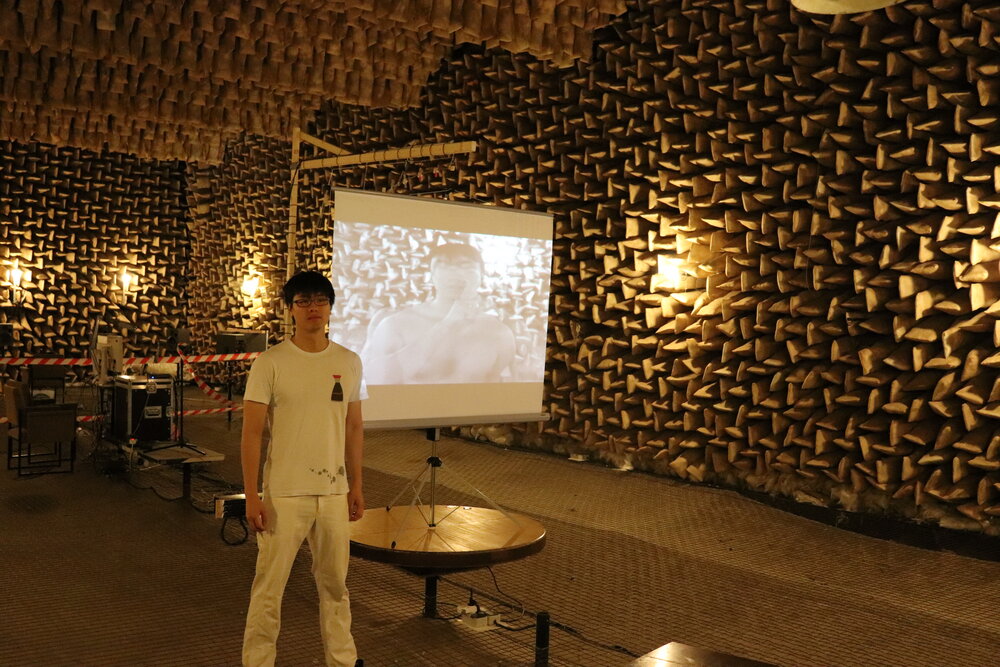
Cover Your Ears! 3, Technische Universität, Dresden
Can you speak about your creative process when improvising and performing in unconventional settings like Inner Fields?
A space can easily dominate and forcibly alter the qualities of a sound, from the size of the room, the number of people in it, even the materials of their clothes, and so forth. While improvising, I make use of these acoustic characteristics by utilizing the full potential of what is called “ideomatic time” which is the process of deterioration of a sound; the transformations of timbre and volume as it deteriorates towards silence.
I recall my performance on the shō at Inner Fields back in 2015, the atmosphere of the room, and how the sound naturally lingered in space. Usually my concerts are recorded and I might tend to think more about the recording than the performance itself, which is obviously a big problem. But since all forms of mechanical recordings were discouraged at Inner Fields, I became aware that each tone I produced was perishing with the natural flow of time. I didn't have to think about the final output because it was happening in the moment. The music itself becomes an experience of Now, and that changes a lot about how I make music in the moment.
What changes?
In a recording session I am directing my sound to the microphone and the unseen audience in the future. But in an improvisational setting without any microphones or any video cameras, the music is just there, lingering in the room. And the space itself becomes an artistic experience. Also, silence is not really wanted in a recording track because you can't really hear the minute details of the deterioration of the sound. But when you’re in a space where everyone is attentive, and everyone is concentrating with you on the music, the deterioration of the sound towards silence is actually the most important thing. It's more important than the sound itself because it's an experience of the time and space that we are experiencing together.
Can you give another example of this?
In the summer of 2016, together with several of my musician friends, I spent some time at the Great Smoky Mountains in Tennessee. On one of our days there, we climbed Mount LeConte via the Bullhead Trail, carrying our instruments to the summit. Approximately 2000 meters above sea level, the hour-long, live, improvisational performance "Resonate the Mountains" was an otherworldly experience, with echoes of sounds reflecting off the mountains below.
I felt in tune with the chorus of mountains.

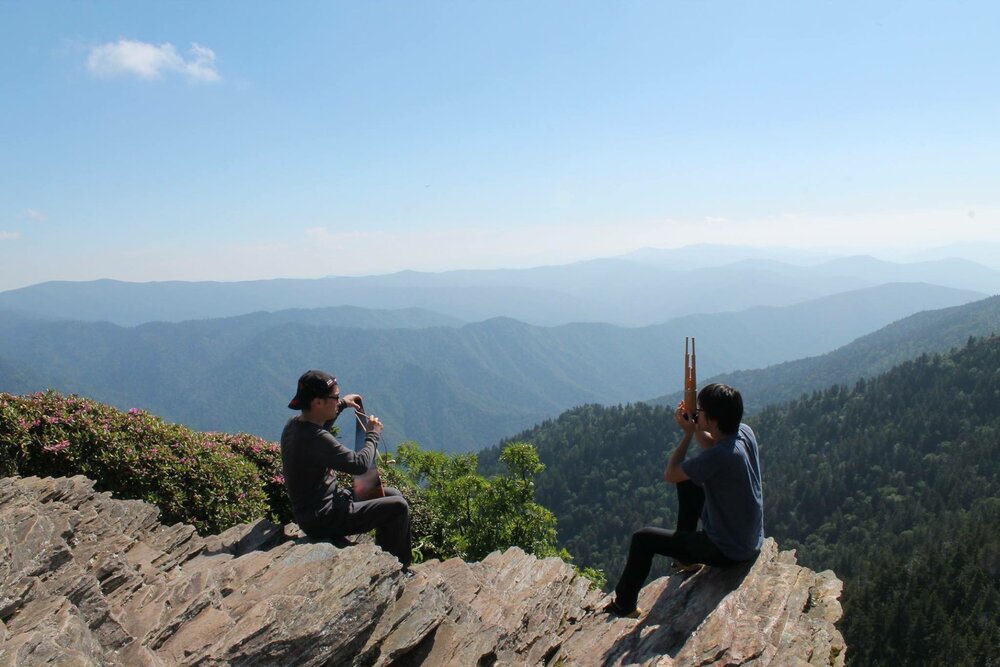
Resonate the Mountains, Tennessee
What quality would you like cultivate more in your life? Why?
I value and cultivate the state of solitude. While the progress of technology allows us to share and communicate with one another with a touch of a screen, we are more anxious and fearful than ever. By no means do I wish to deny the significance of socializing; I am incredibly grateful for all my friends who have endured me for all these years. However, being alone in nature and letting my mind wander freely, I have realized that a big part of my actions in everyday life were in fact not a result of conscious decisions or a reflection of my true self, rather they’re about maintaining social norms.
While camping in the Okutama mountains, every morning when I unzipped my tent I was able to witness the immutable mountain ranges, and beyond that, Mt. Fuji. This experience revealed to me how insignificant our anxieties and doubts can be when confronted with nature.
Being intentionally and voluntarily alone can be achieved through various ways; taking a walk alone in the woods, exploring a foreign city where you do not speak the language, or shutting off your smartphone for a couple of hours, are all forms of solitudes.
How has creativity expressed itself for you as a result of the lockdown and pandemic?
I'm composing a new piece right now for electric guitar and the electric guitarist is actually in Japan. So in a way, the pandemic brought us together in the sense that I may not have thought of the idea of collaborating with somebody halfway across the world, and just with a screen. I actually have a whole notebook of things I do everyday to keep productive. This one is kind of silly but I'm also growing a tomato from a seed and I'm actually recording the whole process of it growing as a piece of video art with an ensemble. This is the type of art I make when I’m forced to be inside and have all of this time by myself!
To close, who or what is the greatest teacher in your life?
Traveling is the greatest teacher in my life. Before the global pandemic, I have been very fortunate to be able to tour and present my works in over 40 cities around the world; spanning from megalopolises like New York City and Shanghai, to humble yet intensely charming towns such as Visby and Auvillar. While traveling, almost nothing goes as planned. I have had countless, unplanned nights on an inflexible, cold bench in near-empty airports, disputes with others resulting from cultural and linguistic misinterpretations, and hospitalizations in over six different countries due to sudden illness or injury. However, there is not one time I regretted the travels I have done. Seeing the break of dawn while crouching on a tight overnight bus seat or having a genuine conversation with an audience member after a disastrous concert of uninterrupted booing and people leaving, makes the trip worthy. What I have gained from my travels are priceless and innumerable.
~~~
To learn more: chatorishimizu.com