The Birth of Inner Fields
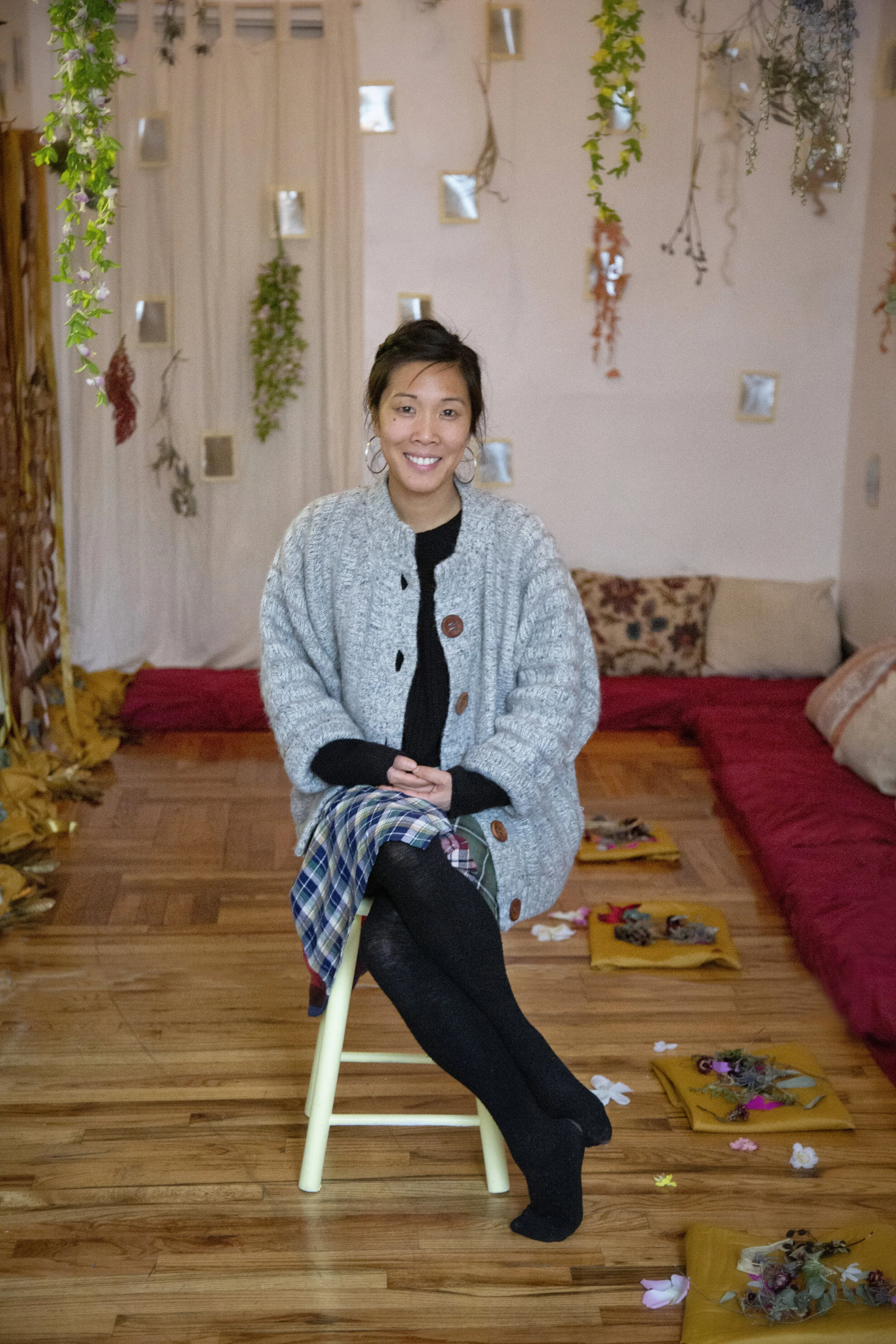
Photo by Georgia Blake
I wrote this piece for our newly launched PATREON page, to introduce myself and attempt to answer the two questions I get asked the most:What is Inner Fields? and Where did she come from?
Thank you to all our new patrons who are helping us enter this next stage of our gift economy. To learn more about our intentions and support our community values, visit us at www.patreon.com/InnerFieldsNYC
My name is Elaine Su-Hui and I founded Inner Fields NY in September 2015 in my apartment in Prospect Heights, Brooklyn. Each week I would invite a different artist, musician or meditation teacher to co-host a unique event with me, exploring ecological consciousness through sound, philosophy, plant medicine, tea ceremony, qi gong, drawing, collage, even feng shui.
This portrait was recently sent to me by my friend, Australian photographer, Georgia Blake. It's a rare one of me at Inner Fields, taken in my home where all our events were held for the first 2+ years. I had never intended to start Inner Fields in my home but I couldn't afford any of the spaces I was interested in, and my #1 rule as an artist is to always work with what you have. At first I was pretty self conscious about not having a more formal space, until I started to realize that inviting people to my home was actually one of the project's secret powers. People in NYC rarely get to hang out in each other's apartments, let alone that of someone they don't know, and it created an immediate intimacy that might not have been as easily cultivated somewhere else.
People often ask me what gave me the idea for Inner Fields and the truth is, she was born out of rebellion! I had been working as a printmaker and following what I had been told was a 'professional' artist path, and yet was feeling increasingly disillusioned with the hyper-commodification of art and ideas, and the largely institutional, transactional nature of the NY artist community. Even the social justice values of an artist could be commercialized and commodified, and conceding to the motivations of a reputation economy was uninspiring and unimpressive to me. The climate crisis cast deep shadows over all my creative work and I cringed over the misdirection of resources and the profligate waste generated by artists, within a system which seemed to colonize all positive cultural movements for its own consumerist purposes.
I'd been helping out a gardener friend (hi Jentle Thumb!) at the then new Pioneer Works garden in Red Hook, Brooklyn, and the sense of innate value I got from simply watering the plants and weeding suddenly felt way more 'real' to me. A public garden is a deep refuge for city-bound people, a place for contemplation, solitude, friendship and rest; a democratic, non-hierarchical space that anyone can participate in. I became interested in the idea of 'making a space' rather than making more 'things' to fill people's houses with. Something that could not even be bought, sold or kept, because its essential nature was that of relationship, connection and community. I read about John Cage and the NY abstract expressionists' Artists' Club back in the 1950s, a space dedicated to the sharing of (white, cis-male) artistic ideas outside of galleries, museums and commercial institutions. I was also interested in architecture designed for contemplation, in particular tea ceremony huts and temples which often include an inner garden for introspection, communion and sanctuary. Spurred by my burgeoning interest in Taoism and Deep Ecology, slowly Inner Fields started to determine her orientation to the sun and plant her first seeds. The confines of the 'inner garden' became a more openly defined 'inner field'; a generative space which inevitably takes many forms because her emergent expression is always collaborative and inherently liberated from elitism. I see her as her own living entity, governed by the potentiality of ideas and the ancient, human need to share wisdom.
I always used to tell people that once they put on their shoes and leave my home, Inner Fields actually doesn't exist anymore. Events were intentionally not photographed or 'captured' in any form, so other than a resonance of feeling, inspiration or insight which you might take away with you, there's nothing material to hang onto, nothing even I can claim to own. As an ecological expression of nature, she is always impermanent, borderless and empty of a separate self. Which is perhaps why, when people ask me, "What is Inner Fields?", I sometimes have trouble defining her and am resistant to limit her by words. I like her nebulous, shape shifting expression. In this way she can speak to many and speak from many; a living, responsive, inclusive entity through which the nobility of all voices can be uplifted, seen and heard.